

Welcome to the Outperform blog page - your ultimate destination for discovering the secrets to unlocking your full potential in the realm of tactical professions. Whether you're striving to achieve your dream career or looking to elevate your fitness for better job performance, we've got you covered.
⚠️Currently undergoing maintenance. Some links may not work correctly
Article Topics:
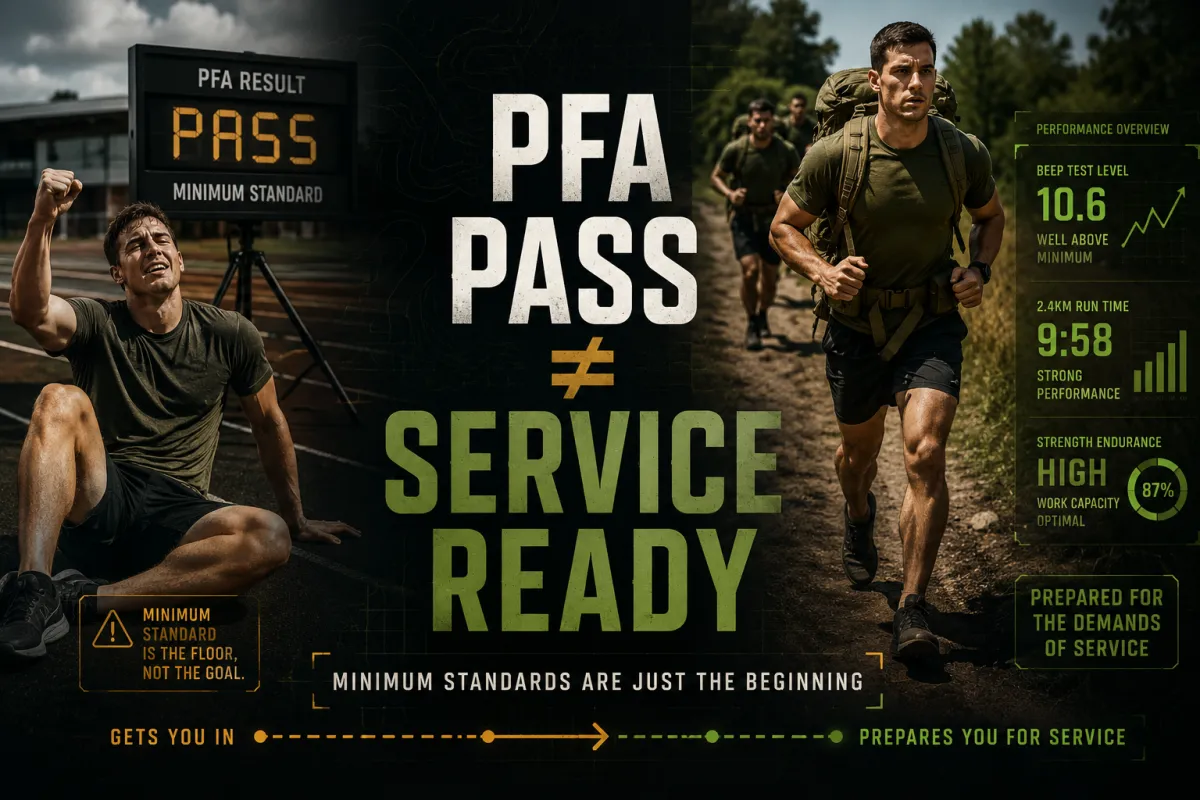
Why Passing the ADF Pre-Entry Fitness Assessment (PFA) Isn’t Enough
Why Passing the ADF Pre-Entry Fitness Assessment (PFA) Isn’t Enough to Prepare for Service
A lot of people preparing for the ADF make the same mistake.
They focus entirely on passing the PFA.
Once they hit the minimum standard or get close to it, they think they’re sorted.
But the reality is, passing the fitness test is only the starting point.
The PFA is designed to make sure you meet the minimum entry requirement. It does not mean you are fully prepared for the physical demands of military training or long-term service.
That’s where a lot of applicants come unstuck.
They stop progressing once they hit the standard, back their training off too much, or try to maintain the bare minimum. Then by the time enlistment, Kapooka, or further training rolls around, their fitness has already dropped off.
What’s Actually Happening
Fitness is not something you achieve once and keep forever.
Your body adapts to what you consistently do.
If you continue training properly, you continue building fitness.
If you stop training or become inconsistent, your conditioning, durability, and fitness levels start declining.
This is one of the biggest things people misunderstand about fitness preparation for the ADF.
They think:
“I passed the test, so I’m ready.”
But tactical fitness does not work like that.
Real preparation is built over time through consistent training, progressing through different phases, and building layers of fitness on top of each other.
That’s why structured progression matters.
You build a base first.
Then you build strength.
Then conditioning.
Then performance.
Then you continue cycling through those phases to keep improving.
You cannot rush straight to the advanced stuff without building the foundation underneath it.
What People Get Wrong
They train only for the test
A lot of applicants train specifically for the beep test, push-ups, or sit-ups and nothing else.
That might help you scrape through the assessment, but it does not prepare you for the broader demands of training and service.
The goal should not be “just pass”.
The goal should be to become physically capable.
They stop training once they hit the standard
This is extremely common.
Someone reaches their PFA target and then backs right off training because they think the hard part is done.
A few weeks or months later, their conditioning drops and they need to build back up again from where they are currently at, not from where they used to be.
Fitness needs to be maintained.
Even maintaining still takes effort.
They try to skip progression
People often want to jump straight into advanced running or high-volume conditioning before their body is ready.
That usually leads to:
niggles
poor recovery
burnout
inconsistent training
stalled progress
If your base is not built properly, the harder training becomes difficult to absorb.
What To Do Instead
Focus on long-term progression
Think bigger than just the PFA.
You should be aiming to progressively build:
conditioning
durability
strength
recovery capacity
running tolerance
The better your base becomes, the more training your body can handle later.
Stay consistent
Consistency matters more than short bursts of motivation.
You do not need to be pushing flat out all year.
Training should cycle through different phases.
Sometimes you are pushing harder.
Sometimes you are rebuilding the base.
Sometimes you are maintaining certain areas while improving others.
That is how long-term progress actually works.
Don’t be afraid to pull back when needed
Sometimes going backwards slightly in training is actually the smarter move long term.
If your running starts feeling out of reach, niggles start building up, or recovery is poor, backing things off slightly can help your body absorb the training better.
Then when you ramp things back up again, you handle it far better the second time through.
That is not failure.
That is smart progression.
Practical Steps For ADF Applicants
1. Stop training only for the minimum standard
Treat the PFA as the baseline, not the end goal.
Aim to build a level of fitness that gives you confidence heading into training, not just enough to scrape through.
2. Build your running progressively
Do not suddenly jump into large amounts of high-intensity running.
Build your conditioning over time so your body can actually absorb the workload.
If you need help improving your beep test performance, check out the Beep Test Guide:
https://info.outperformfitness.com.au/beeptest
3. Stay training after reaching your goal
Once you hit a goal, start focusing on the next one.
Fitness is built through long-term consistency and progression, not one short burst of effort.
4. Respect the process
Good training is structured.
Different phases exist for a reason.
You build one system on top of another over time.
Trying to skip ahead usually slows progress down in the long run.
5. Learn from people who have already gone through it
One of the best things you can do is learn from people who have already prepared for and gone through service.
You can check out the Tactical Career Chats playlist here:
https://www.youtube.com/playlist?list=PLHsLBHL3xi9zD-Hzjvf9EANU_HMPm0fLN
Summary
Passing the PFA is not the finish line.
It is the starting point.
Real preparation for the ADF comes from building long-term fitness through structured progression, consistency, and smart training.
Fitness is not something you achieve once.
It is something you continuously build and maintain over time.
If you focus on building a bigger base, staying consistent, and progressing properly, you put yourself in a far better position not only to pass the test, but to handle the demands of training and service afterwards.
If you want structured coaching and progression designed specifically for ADF preparation, check out the Fit For Service Training Plan:
https://info.outperformfitness.com.au/getbattleready
FAQ
Is passing the ADF PFA enough to prepare for Kapooka?
No.
The PFA is the minimum entry requirement. You should aim to build a higher level of conditioning, durability, and fitness before starting training.
Why do people lose fitness after passing the PFA?
Because fitness declines when training consistency drops.
You do not permanently keep fitness once you achieve it.
Should I keep training after passing the fitness test?
Yes.
Maintaining fitness still requires ongoing effort and consistency.
Why does structured progression matter in training?
Because your body needs time to build the foundation required for harder training later on.
Skipping progression often leads to stalled progress or injuries.
Is it bad to repeat phases or reduce training temporarily?
No.
Sometimes pulling training back slightly helps your body absorb training better and improves long-term progress.

WANT TO GET
BATTLE READY?
Specialised online fit-prep program for ADF & First Responder applicants
Copyright Outperform Fitness © 2023.